Japan City Hall All in One for New Residents
👋 Hey everyone! It’s your friend from Nyuuly – your go-to guide for a stress-free move to Japan.
Welcome to your new home in the Land of the Rising Sun! 🎉
In your first week, you’ll need to take care of three key paper work:
1. Register your Residency (住民登録, Jumin toroku)
2. Get the Certificate of Residence (住民票を取得,Juminhyo o shutoku)
3. Enroll in Health Insurance & Pension (if you are not employed by a company) (健康保険&国民年金の新規加入, Kenkōhoken & kokumin nenkin no shinki kanyu)
As a brand-new resident, this can feel overwhelming and time-consuming. But don’t worry—Nyuuly is here to help you simplify the process.We will show you how to complete everything in just one trip to your local city hall (municipal office). We are all about efficiency!
⏰ When to Go: Timing Your Trip to City Hall
Your first visit should be within the first or second week of your arrival. Don’t delay, as it’s required by law.
Nyuuly’s pro tip: Most city halls open at 8:30 AM and close at 5:00 PM. Plan to arrive as early as you can to avoid long lines and give yourself enough time to get everything done. (approx. 2-3 hours)
🗺️ Where to Go: Research Your City Hall Before Going
Before heading out, do a quick search with your district name and the keyword 役所 yakusho
Each district usually has:
- One main ward office (区役所, Kuyakusho or 市役所, Shiyakusho)
- Several general branch offices (総合支所 - Sogo Shisho)
You can choose whichever location is closest and most convenient for you.
🎒What to Bring: Good preparation makes a smooth trip!
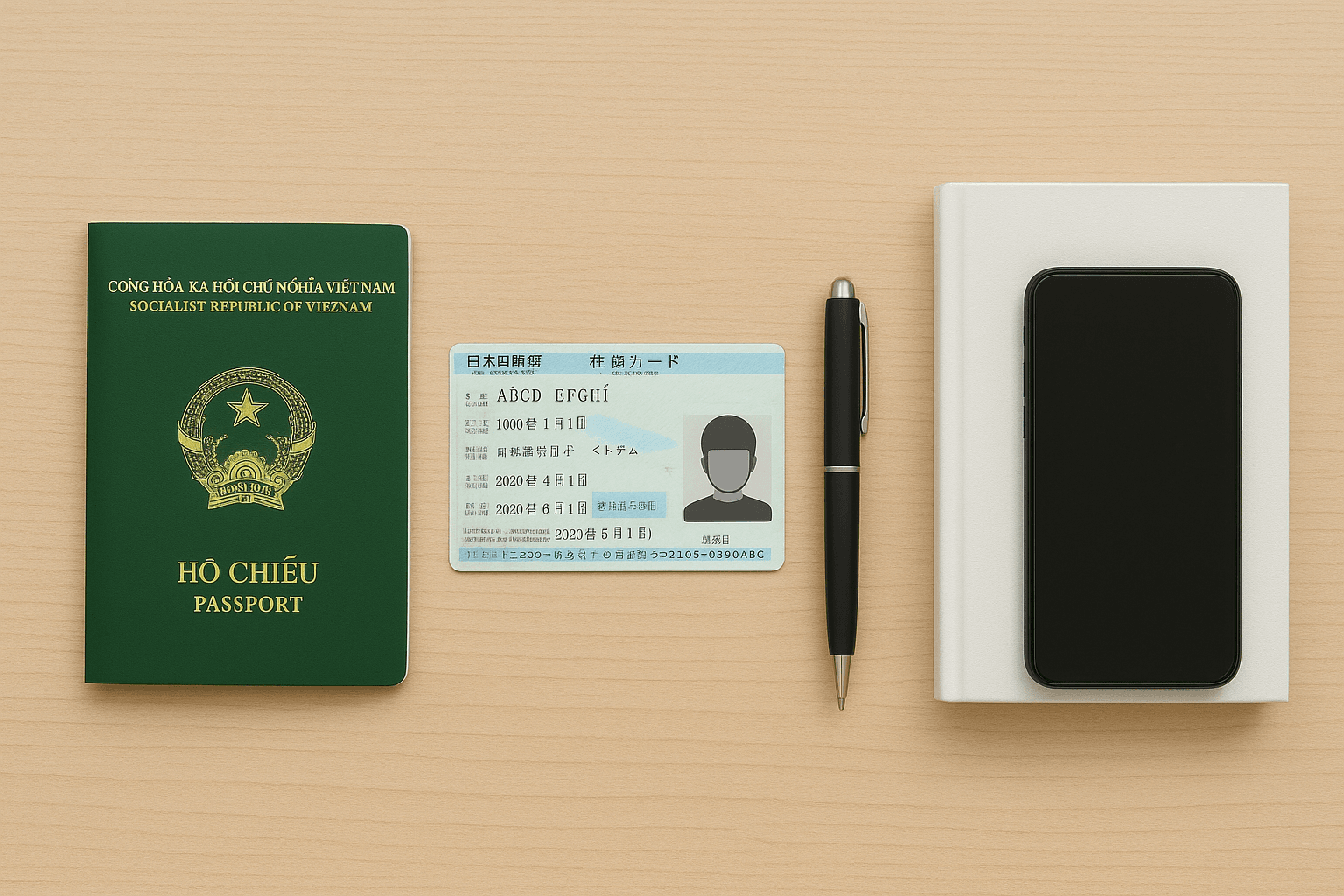
Don’t let missing documents slow you down! Make sure you’ve packed the following before heading to city hall:
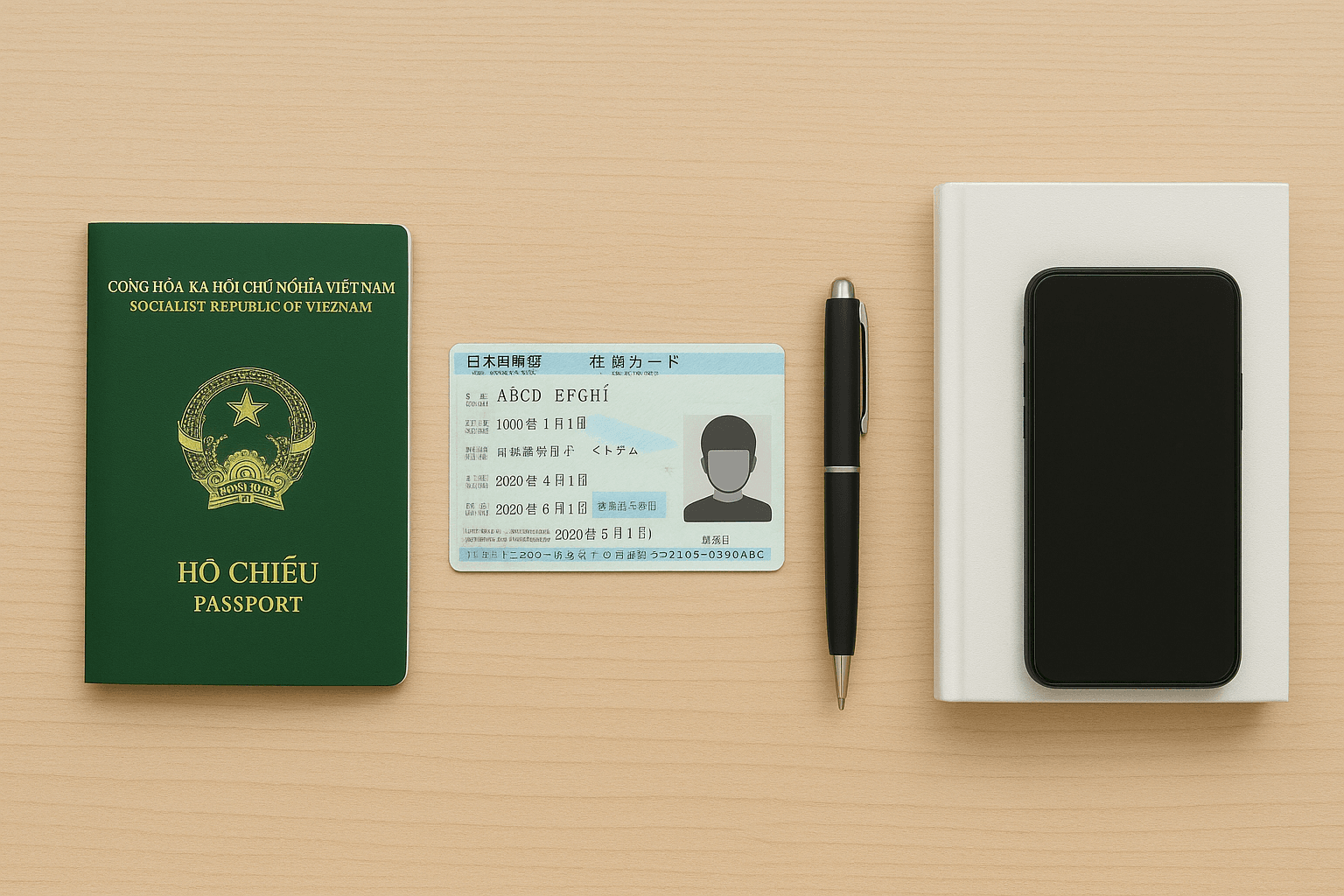
MUST:
- Passport (パスポート, Pasupoto)
- Residence Card (在留カード, Zairyu Kado) - Which you received at the airport when you landed in Japan.
EXTRAS:
- Pen (ペン, Pen)
- Fully charged phone and a book (to survive the waiting time).
🏢 How It Goes: The common work-flow of the City Hall
When you arrive at city hall, a staff member will usually greet you and ask what you need to do. Just say the Japanese keyword for your task (see the sections below), or have it ready in Google Translate and show them.
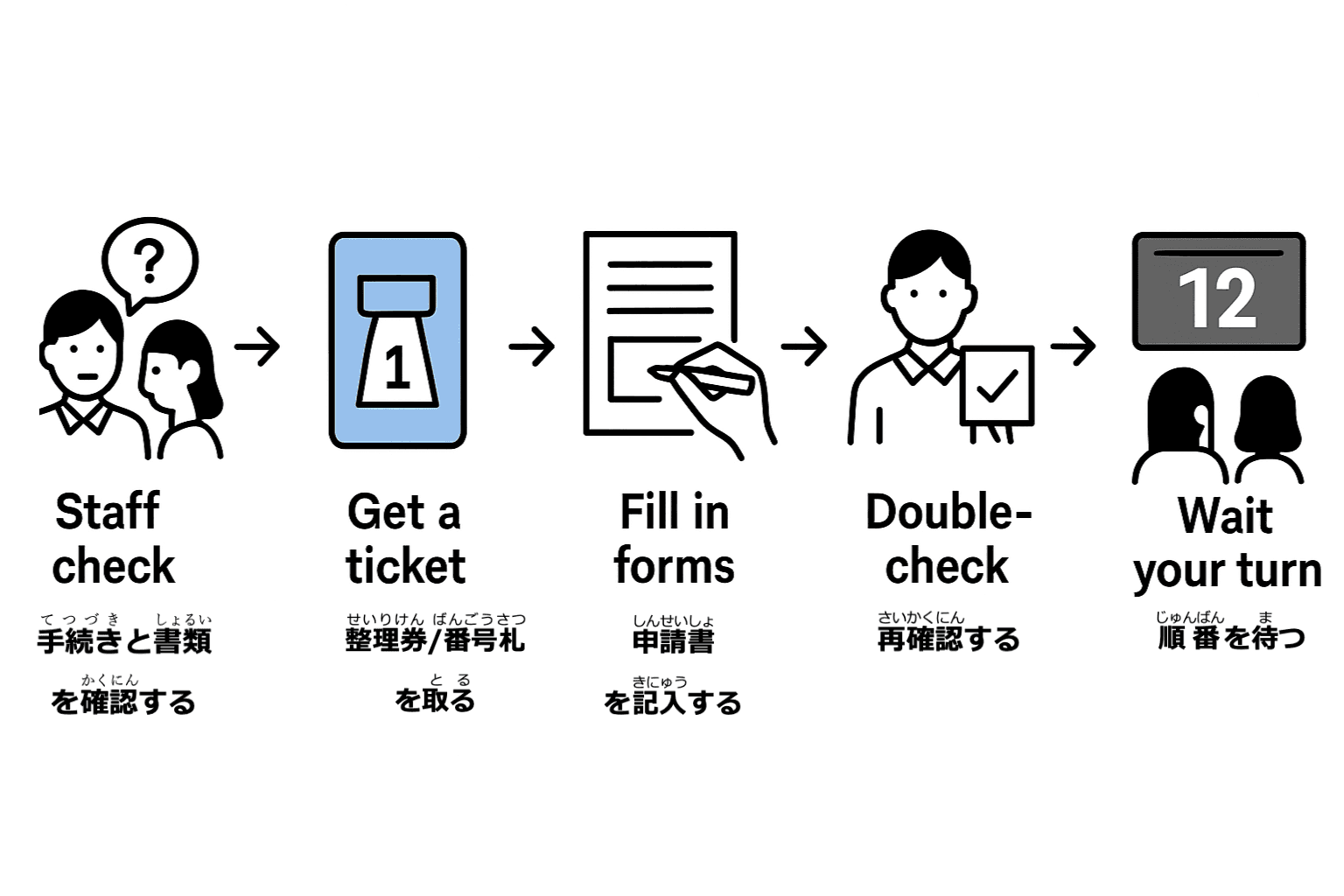
The usual flow looks like this:
- Staff check – The staff will ask what procedures (手続き, tetsuzuki) you would like to do, what documents (書類, shorui) you brought and guide you to the next steps.
- Get a ticket (整理券/番号札を取る, Seiriken/Bango-fuda wo toru) – You’ll be guided to a machine to take a number ticket.
- Fill in forms (申請書/ フォームを記入する, Shinseisho/Fomu wo kinyu suru) – While waiting, staff will point you to a table with the forms you need. Don’t worry—there’s almost always a sample form already filled in that you can copy.
- Double-check – Once you finish filling out the form, you can ask the staff to check it before you submit by saying: 再確認していただけますでしょうか (Saikakunin shite itadakemasu deshō ka)
- Wait your turn – Pay attention to the number on the electronic board and wait until your number is called.
Now, let’s dive into our task list!
Task 1: Register your Residency (住民登録, Jūmin tōroku)
What it is:
Your very first step is registering your new address. This is how you officially become a resident of your city. It unlocks everything else—insurance, pension, My number card, bank account,...
Nyuuly’s pro tip: You usually need to go in person to your local ward or city office for this task. You can register for your family on their behalf (Roommates cannot register on behalf of each other).
How to do it:
- Staff will guide you to take a number at the ticket machine for the counter for residency registration.
- Fill out a Move-in Notification (転入届 / Tennyū Todoke), and submit to the counter that call your ticket number.
- Wait for the staff to call you once your registration is completed.
What happens after you applied:
- The staff will update the address on the back of your Residence Card and hand you back the card the same day.
Cost: Good news, this procedure is free of charge.
Task 2: Get Your Certificate of Residence (住民票を取得する,Juminhyo o shutoku suru)
What it is:
Certificate of Residence (住民票, Juminhyo) is an official certificate that proves your registered address in Japan. You’ll need it often—for opening a bank account, submitting to your employer,..
How to get it:
- Right after you finish registering your residency, simply ask the staff at the counter: 住民票をお願いします ( Juminhyu o onegaishimasu)
- Fill in the form to select what information you would like to have on your certificate.
- They will print it out for you on the spot, and you'll receive a stamped paper certificate of residence with your name, address, and personal details.
Cost:
Around ¥300 per copy (varies slightly by city).
Nyuuly’s Pro Tip Get one or two copies right away, saving you an extra trip later!
You can also easily get this document at any convenience store in Japan so you don't need to stock up too much!
(Visit our blog on how to master Japanese convenience stores here for more details)
Task 3: Enroll in Health Insurance & Pension(健康保険&国民年金の新規加入, Kenkōhoken & kokumin nenkin no shinki kanyu)
If you are not employed by a company, you are required to enroll in Japan National Health Insurance and the National Pension.
After your address is registered, you can enroll on the same day, same city hall.
National Health Insurance (国民健康保険, Kokumin Kenkō Hoken)
What it is:
If you’re self-employed, unemployed, or not covered by a company plan, you must enroll in National Health Insurance. It helps cover most of your medical costs, so you usually pay only about 30% when visiting hospitals or clinics.
How to get it:
When you submit your form to Register your Residency (Task 1), the staff will ask if you want to enroll in the National Health Insurance system, simply say yes and they will apply for you.
What happens after you applied:
Once you’ve completed your enrollment, you usually don’t get your health insurance card right away. The city hall will mail it to your registered address, which typically takes 1–2 weeks.
Cost: You will get a Payment notice (支払通知書, Shiharai Tsūchisho) with the amount of cost from the government every month, which you can use to pay at convenience stores or pay online.
NyuuLy’s Pro tip: If you need to see a doctor before your card arrives, ask the staff for a temporary certificate (資格取得証明書 / Shikaku Shutoku Shomeisho). This proves you’re enrolled and can be used for medical treatment until your official card comes.
National Pension (国民年金, Kokumin Nenkin)
What it is:
This public pension system ensures you receive a basic retirement, disability, and survivor’s pension, with contributions required from all residents aged 20–59. If you’re not enrolled in a company pension plan, you must sign up for National Pension at your local city hall after registering your address, even if you do have plan to retire in Japan (yet)
How to get it:
- Take a number at the ticket machine again for the counter for health insurance enrollment.
- Fill in the National Pension Enrollment Form (国民年金の申込書, Kokumin Nenkin no mōshikomisho) and submit it at the counter.
- Wait for the staff to call you once your registration is complete.
What happens after you apply:
- After submitting your enrollment form for the National Pension, the city hall will mail your official pension number and related documents to your registered address within a few weeks.
Cost: You will get a Payment notice ( 支払通知書, Shiharai Tsuchisho) with the amount of cost from the government every month, which you can use to pay at convenience stores or pay online.
NyuuLy’s Pro tip: Keep these documents safe—they include your pension number, which you’ll need for future contributions, claiming benefits, or any correspondence with the pension office.
Exemption in Japan’s Pension System
If paying the pension premiums becomes difficult because you have a disability, or you are a student or your income is low, there are official exemption and postponement schemes you can apply for.
What are these schemes?
- 免除 (Menjo, Exemption): You apply and if approved, you pay nothing (or a reduced amount) for your pension premiums.
- 猶予 (Yuyo, Postponement): You apply and your payment is delayed (you don’t pay now). Later you may have the option to pay (追納) if you want full benefits.
- 学生納付特例制度 (Gakusei nofu tokurei seido, Student Payment Special Exception): Specifically for students who are over age 20 and whose income is below a certain threshold. They can apply for a postponement of payment.
Who can apply? Key cases
- If your income (and your household’s) is below a certain level and it’s hard to pay, you can apply for exemption (全額, zengaku, full/一部免除, ichibu menjo, partial) or postponement.
- If you are a student (age 20+), you may apply under the Student Payment Special Exception, meaning you don’t pay while studying (if you pass the income check).
- If you are receiving welfare (生活保護, seikatsu hogo) or a disability pension (障害基礎年金, shogai kiso nenkin or 障害厚生年金, kogai kosei nenkin) at grade 2 or higher, your National Pension premiums may be exempted (法定免除制度, houtei menjyo seido). The exemption applies from the month before your certification for the disability pension.
Why should you apply?
- Applying properly keeps your pension record active. Even if you are exempted, you still count toward the qualification years for old-age pension (“受給資格期間, jukyu shikaku kikan”).
- If you don’t apply and simply stop paying, you might lose eligibility for pension benefits (e.g., disability or survivors pension) or your benefits might be reduced.
- Later you have an option to make up for exempted or postponed periods by “追納, tsuino (catch-up payments)”, which can increase your pension amount.
Care to Make This Trip Even More Efficient?
While you’re already at city hall, consider handling these extras to save yourself another trip:
- Garbage & Recycling Guide (ゴミ/ リサイクルガイド, Gomi / Risaikuru Gaido) – most municipalities provide a handbook on how to separate and dispose of waste.
- Bicycle Registration (自転車登録 , Jitensha Toroku) – some areas allow you to register your bike at city hall.
- Tax-related Notices (税務関連通知, Zeimu Kanren Tsuchi) – if you’re freelancing or not employed by a company, you can ask about the local tax desk.
- Guidance on emergency evacuation (避難指導案内, Hinan Shigo Annai) (when there is an earthquake, tsunami,...)
- Seal Registration (印鑑登録, Inkan Toroku) – This is not mandatory. You will only need a registered seal only for large purchases like a house or car.
These aren’t always required on day one, but since you’re there, why not?
Wrap-Up: Every visit marks a new milestone in your Japan journey
That’s it! With your residency registration, proof of residence, My Number Card application, and health insurance & pension enrollment all done in one visit, you’ve checked off the biggest items on your first-week-in-Japan to-do list. 🎉
If you stay in Japan long term, you’ll return to City Hall for other life events, such as:
- Moving out of or into a new apartment (転出/転入手続き,Tenshutsu / Tennyu Tetsuzuki)
- Changing your marital status and name (婚姻/氏名状況変更届, Konin/Shimei Jokyo Henko Todoke)
- Registering the birth of a child (出生届, Shussei Todoke)
So each trip to the City Hall marks an important milestone in your life here. It is a part of your journey—so enjoy it and enjoy Japan! 🇯🇵✨